
Meta Advertising for Ecommerce: The Complete 2026 Guide
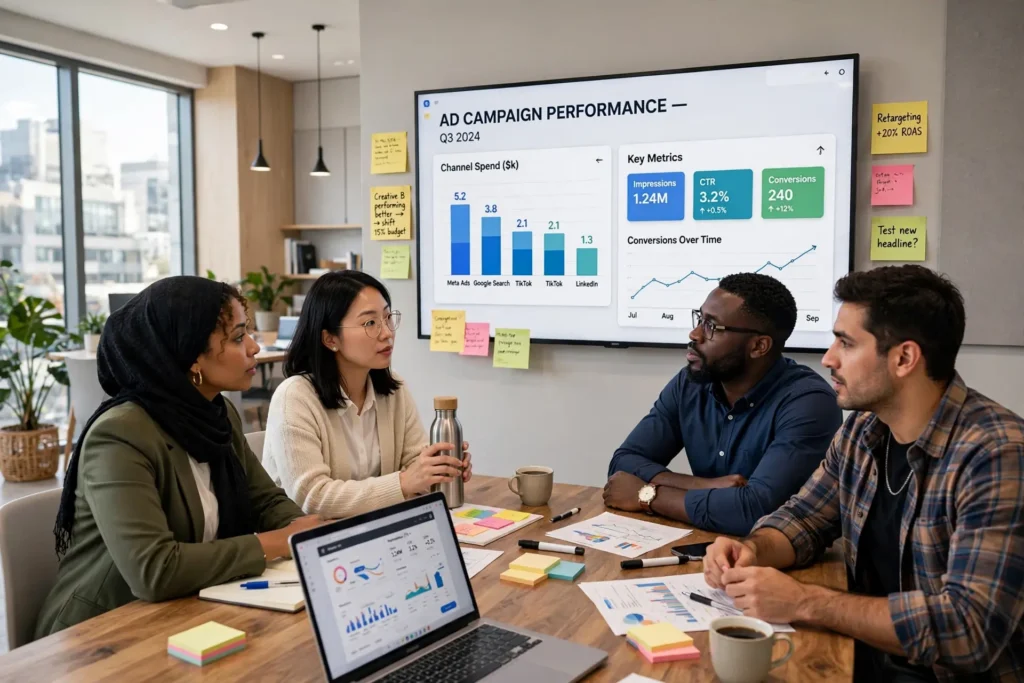
Meta advertising is paid advertising across Meta’s platforms, including Facebook, Instagram, Messenger, and the Audience Network, all managed through Meta Ads Manager. For ecommerce brands, it means putting your products in front of precisely targeted shoppers and then tracking every click, add-to-cart, and purchase back to the ad that caused it.
In 2026, Meta still commands roughly 35% of all ecommerce ad spend, sitting behind Google at about 45% and ahead of TikTok at about 12%. That makes understanding meta marketing non-optional for any DTC brand that wants to scale. This guide covers everything an ecommerce founder needs to know: how Meta advertising works, the campaign types that matter, what it costs, what’s new in 2026, and how to get started.
How Meta Advertising Works
Every meta ad campaign runs on three things: the auction, the algorithm, and the creative. The auction decides who sees your ad based on your bid, your creative’s estimated engagement, and overall ad quality. You are not buying fixed placements, you are competing in real time for attention.
The algorithm is where Meta’s AI finds buyers using signals from your Pixel, Conversions API (CAPI), and product catalog. The more clean purchase data you feed it, the better it gets. In 2026 this matters more than ever, because targeting skill is being replaced by signal quality.
The third piece is the creative itself, whether that is a video, an image, or a carousel. Creative is now the primary targeting lever, since Meta shows your ad to the people most likely to respond to that specific creative. For ecommerce, the standard setup is to install the Pixel and CAPI on your store, connect your product catalog, launch a Sales campaign, and let Meta optimize toward purchases.
Meta Advertising Solutions for Ecommerce Brands
Meta offers several advertising solutions built specifically for online stores. Advantage+ sales campaigns are Meta’s AI-driven campaign type that automates targeting, placements, and budget allocation. In 2026, this is the default starting point for most DTC brands: one campaign, broad targeting, and the creative doing the heavy lifting.
Meta Shop ads drive shoppers directly into your Facebook or Instagram Shop for a native checkout experience. This means lower friction, which is especially strong on mobile. Catalog or dynamic ads automatically show shoppers the exact products they viewed on your site, and they are the backbone of every retargeting setup.
Lead ads use instant forms inside Facebook and Instagram to collect emails or phone numbers without the user leaving the app. For ecommerce, they work best for pre-launch waitlists, quiz funnels, and SMS list building, not as a replacement for purchase campaigns. Finally, partnership or creator ads let you run paid campaigns through a creator’s handle instead of your brand page. Since Meta merged its creator tools into the Creator Marketing Hub in late 2026, creators can pre-approve partnerships, which makes whitelisted UGC-style ads far easier to scale.
Meta Ad Campaign Types Every Ecommerce Brand Should Know
Inside Ads Manager, you choose an objective for each campaign, and the right one depends on what you want the ad to achieve. The Sales objective drives purchases on your website or Shop, and it is your money-maker. Traffic sends visitors to product or landing pages, which is better for testing than scaling. Engagement warms up audiences with video views and post interactions, while Leads builds your email or SMS list with instant forms. App promotion only makes sense if you have a shopping app.
As a rule of thumb, 80% or more of an ecommerce budget should sit in Sales campaigns. The rest supports testing and list building.
Why Meta Marketing Still Wins in 2026
There are three reasons meta marketing remains the highest-leverage channel for DTC brands. The first is scale and intent in one place. Billions of people use Facebook and Instagram daily, and Meta has tracked their purchase behavior for over a decade. No other social platform matches that combination.
The second reason is that costs have stabilized. After sharp increases in 2022 and 2023, Meta CPMs are roughly flat year over year in most verticals, although Q4 still spikes 30 to 50% seasonally. Google CPCs, meanwhile, keep climbing 8 to 12% annually.
The third reason is creative-first performance. In 2026, hook-first video ads achieve around 2.1x higher engagement and 34% lower cost-per-acquisition than static images. Brands that master short, native-feeling creative win, while media buying mechanics matter less than they used to. The direction is also clear: Meta plans fully automated ad creation by late 2026, where a business inputs a URL and budget and AI handles creative, targeting, and optimization. The brands feeding the cleanest data today will win that era.
How Much Do Meta Ads Cost for Ecommerce?
There is no fixed price, since you bid in an auction, but 2026 benchmarks give a realistic range. Fashion and apparel brands typically see a CPA of $22 to $45 with a ROAS of 3x to 5x. Beauty and cosmetics see a CPA of $18 to $35 with a ROAS of 4x to 7x, and health and supplements see a CPA of $30 to $55 with a ROAS of 3x to 5x. These are industry benchmarks, and your own numbers will depend on AOV, creative quality, and offer strength.
For context, here is what these benchmarks look like in real accounts we manage at Sellic. Mitti Mart, a two-month-old clay cookware brand, turned Rs 105,815 in ad spend into Rs 916,442 in revenue, an 8.66 ROAS across 295 purchases. UrbanBuck, a five-month-old fashion brand, turned Rs 156,831 in ad spend into Rs 803,569 in revenue, a 5.12 ROAS across 455 purchases. RUKH, another fashion brand, has spent Rs 4.33M over its lifetime and generated Rs 18.2M in tracked sales value, around a 4.2x blended ROAS.
A practical starting budget for testing is $20 to $50 per day, or Rs 3,000 to Rs 7,000 per day in Pakistan. Give any test at least 3 to 4 days and 50 conversion events before judging it.
How to Get Started with Meta Ads
Start by installing the Pixel and Conversions API on your store. Shopify’s native integration covers both. Next, connect your product catalog through Commerce Manager, which is required for dynamic and Shop ads. Then prepare three to five creatives: at least two hook-first UGC-style videos, one product demo, and one offer-led static.
Once your creatives are ready, launch one Advantage+ sales campaign with broad targeting and purchases as the conversion event. Set your kill rules before you spend. For example, if an ad set gets no sales after spending about 1.5x your target CPA, turn it off, and do the same if CPA is 50% or more above target after meaningful spend. When you find winners, scale them gradually by increasing the budget 20 to 30% every two to three days on proven ad sets, or by duplicating them into a scaling campaign.
Final Word
Meta advertising in 2026 is simpler to launch and harder to master than ever. The platform automates the mechanics, so your edge comes from creative quality, clean data, and disciplined testing. Brands that treat Meta as a creative-testing machine, not a “set and forget” traffic tap, are the ones compounding ROAS year after year.